Chicken Road Strategy: Difficulty, Cash-Out Timing and Bankroll
Last verified: August 2026
Chicken Road Strategy Basics: Risk vs Reward
There is no underlying system that outperforms Chicken Road since the game is based on independent probability, and grasping this concept is actually the first step in forming any strategy. Every move you make is a separate event; the chances that the next move will be safe are not affected by what occurred in the previous round, the ten rounds before that, or any pattern you may have detected. Chicken Road has no memory.
The only things that you can control are three levers: the amount that you stake, the difficulty level that you choose, and the cash-out point that you set. That's all there is to it. The size of the stake determines how much you risk in each round. The difficulty level determines how frequently a step is safe and how high the multiplier can go. The cash-out point determines whether you take in a smaller but more probable win or wait and take a larger but less probable one.
What it means to play smart is to use the three levers on purpose—for example, by selecting a fixed stake of PKR 50–100 on Medium difficulty and setting a cash-out target before the round begins—rather than pursuing a 'strategy' which promises guaranteed profits. None of the staking patterns, timing tricks, or betting progression systems can alter the basic odds at each step.
Difficulty Levels and What They Mean for Strategy
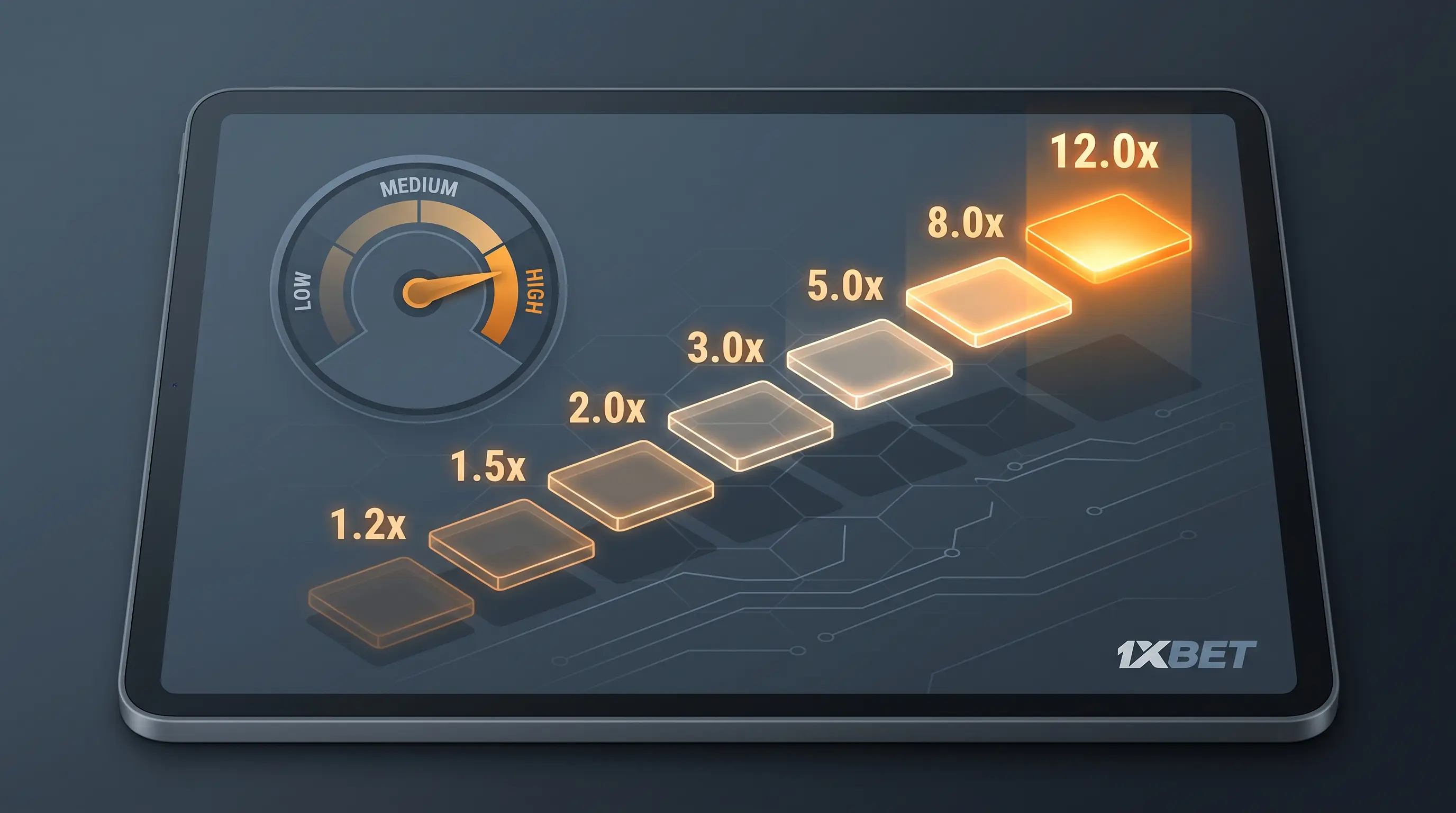
Since difficulty has the greatest impact on both your chances of success and the highest level you can reach, it deserves a more detailed examination before you make your choice. At each level, two things change: the frequency with which a step fails and the height to which the multiplier can rise before the road ends. Third-party reviews of the game, such as those from ClashOfSlots, CrashGamesPlay, and Tribuna, give the approximate figures as follows:
| Difficulty | Steps | Approx. fail chance per step | Approx. max multiplier |
| Easy | 24 | ~4% | up to ~x24.5 |
| Medium | 22 | ~12% | up to ~x2,254 (some sources ~x1,788) |
| Hard | 20 | ~20% | up to ~x52,067 |
| Hardcore | 15 (10 of 25 tiles are “deadly”) | ~40% | up to ~x3,203,384.8 |
The numbers are based on third-party reviews rather than on an official 1xBet or InOut Games paytable and may differ according to the version, so it is necessary to check the exact figures in the live game client before relying on them.
Easy is suitable for anyone wishing to have a long and steady session with a series of small, frequent wins and a low probability of going bust, and it is also the best mode for developing cash-out discipline in demo mode before progressing to real money. Medium occupies a middle position: it still has a manageable failure rate per step, but the high multiplier cap makes it worth considering if you are comfortable with greater variance. Hard and Hardcore are appropriate for players who accept that most rounds will conclude within the first few steps, in return for the chance of achieving a very high multiplier, so they are suited to a small and clearly defined portion of your bankroll rather than your main stake. Whatever level you select, you should remember that the chance of failing resets on each individual step, meaning that even after a long sequence of safe steps the next one is no less risky.
Cash-Out Discipline and Bankroll Management
In Chicken Road the strategy is less concerned with the game itself and more about how you handle your own decisions regarding it, and this begins before you even press start; you should set your cash-out target as a fixed multiplier rather than a feeling that you'll assess at the time, because the multiplier rising in real time makes almost everyone want to push one more step.
The rule for determining bankroll size is the same: on Easy or Medium you should stake about 1 to 2% of your session bankroll per round, but on Hardcore this should be reduced to about 0.5% since the failure rate is much higher. If your session bankroll is 2,000 PKR, your stake should be in the range of 20 to 40 PKR on the easier levels and around 10 PKR on Hardcore.
A stop-loss is just as important as a cash-out target; decide beforehand that you'll stop playing when your session bankroll has dropped by, for example, 40 per cent and regard that figure as final, not as a recommendation to carry on to the next round. It is precisely by pursuing losses by increasing your stake in an attempt to recover the amount you've lost that a reasonably controlled session becomes an expensive one.
A better strategy is to deal with profits when you are in a position to do so rather than drawing again from your initial bankroll, and to leave the game when either your cash-out goal or your stop-loss has been reached. Since this is merely a form of entertainment and not a source of income, you should only risk money that you are fully at ease about losing and limit yourself to 18+.
Why Chicken Road Predictors, Hacks and Signals Don't Work
If you look around for content on the Chicken Road strategy game, you'll come across predictor apps, Telegram signal groups, and hacked or modified APKs that claim to show you the next safe move before you make it. These don't work at all, and the reason for this goes directly back to how the game is constructed.
Chicken Road uses a provably fair system since the result of each round is generated and cryptographically hashed before the round actually starts, with a seed that neither you nor the operator can change once the game has begun. The result has nothing to do with the outcomes of the previous rounds, the particular app you have installed, or any pattern that a bot says it detects. There is no live feed of the forthcoming results for a predictor to catch, since the result is already in encrypted form the moment the round loads.
On that basis, a tool which says it can predict, unlock, or manipulate the outcomes of Chicken Road is not offering a shortcut—it is providing a scam. Predictor apps and paid signal groups usually charge a subscription fee and all they give is general advice presented as insider information. Hackings or modified APK files are even more serious: one common way of doing this is by installing an unofficial app file obtained from outside an official app store, which involves handing over your account details, payment information, or access to your device to the person who made the app.
If someone offers a guaranteed system, a leaked algorithm, or a working predictor for Chicken Road, treat this as a warning sign rather than a chance, and use only the official game client on 1xBet.
FAQ
Can there be a guaranteed strategy for the Chicken Road?
Not at all. Chicken Road is based on independent and provably fair probability, which means that no particular staking pattern or timing trick can affect the odds of any given step. The only genuine factors that you can adjust are the stake amount, the difficulty, and the time at which you cash out.
What's the safest difficulty?
Easy is the most safe option since each step has a high probability of being safe and the multiplier has a low ceiling; it therefore provides the best starting point if one is trying to develop cash-out discipline before moving on to higher-risk levels.
Do prediction apps work?
Not at all; the result of each round is generated and hashed before the round begins, without any influence from an app, a bot, or a signal group. Predictor programmes and hacked APKs do not show the results—many of them are scams which steal money or account information.
How much ought I to stake in each round?
A widely followed rule of thumb is to risk 1 to 2 per cent of your session bankroll on the Easy or Medium settings, but this amount should be reduced to about 0.5 per cent when playing on Hardcore, since the failure rate is considerably higher.
How many Pakistani Rupees should I bet per round?
There's no fixed number, but the same 1–2% of your session bankroll rule applies in PKR just as in any other currency — for example, a PKR 2,000 bankroll works out to roughly PKR 20–40 per round on Easy or Medium, dropping to around PKR 10 on Hardcore.